
Why Your Garment Costing Never Matches Actual Production: 7 Hidden Leaks
Costing says 1.35 kg of fabric per dozen. The store says 1.52. Here are the seven places garment factories lose margin between the order sheet and the floor, and how to measure each one
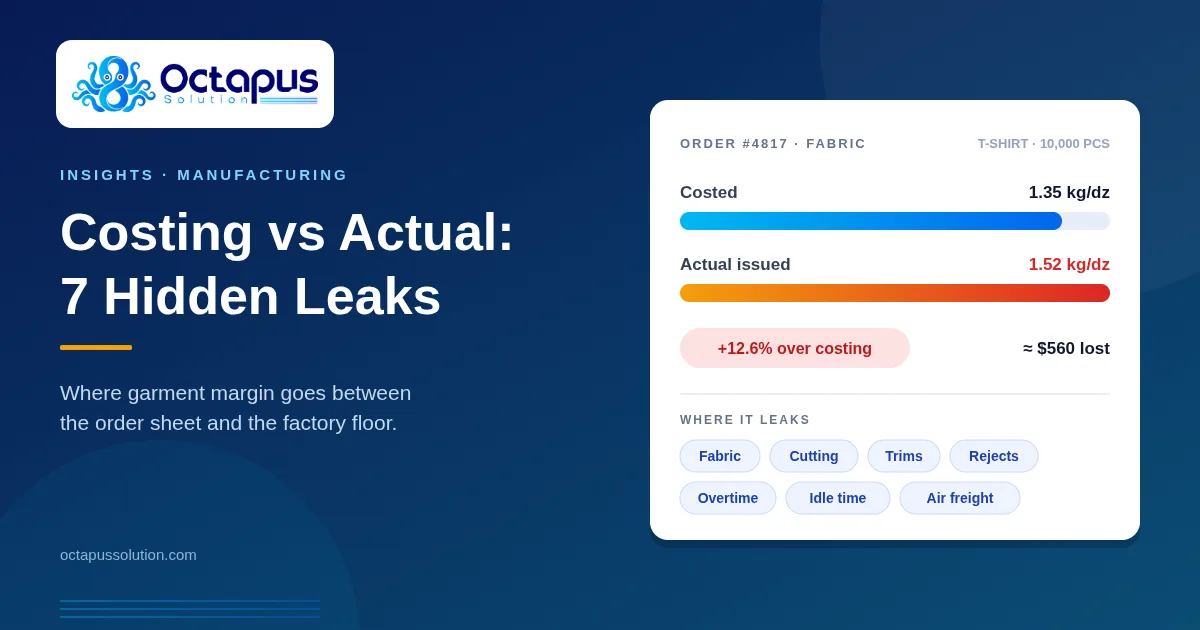
The merchandiser costed the order at 1.35 kg of fabric per dozen. The order shipped on time; the buyer was happy, and everyone moved on. Three weeks later, accounts closed the books and found the store had issued 1.52 kg per dozen.
That gap is about 12.6%. On a 10,000-piece order (roughly 833 dozen), it comes to around 140 kg of extra fabric. At $4.00 per kg, that's about $560 gone from one style, before anyone has counted trims, rejects, or overtime.
Most factories don't lose margin through one big mistake. They lose it in small, normal-looking gaps between what the cost sheet assumed and what actually happened on the floor. The trouble is that these gaps are rarely measured, so nobody can say which order made money and which one only looked like it did.
Here are the seven places it usually leaks, and how to measure each one.
1. Fabric consumption variance
What happens: The cost sheet uses a consumption figure from the sample or a standard marker. In bulk, the real marker efficiency is lower, the fabric width arrives narrower than ordered, or shrinkage after washing is higher than allowed for.
How to measure it: For every order, record three numbers: costed consumption per dozen, marker consumption per dozen, and actual issued consumption per dozen (fabric issued divided by pieces cut). If the difference between marker and actual is large, the problem is on the cutting floor. If the difference between costing and marker is large, the problem is in costing.
Quick win: Check the actual cuttable width when fabric arrives, before cutting starts, and recalculate the marker if it's different from what was ordered.
2. Cutting wastage that nobody records
What happens: End bits, splicing losses, and panels re-cut because of fabric faults or shade problems. Re-cut fabric usually comes from the same roll allocation, so it disappears into "normal consumption."
How to measure it: Log re-cut panels with a reason code (fabric fault, shade, cutting error). Even a simple daily count per order shows which supplier, which cutter, or which fabric type causes the most re-cutting.
3. Trims over-issue
What happens: Buttons, labels, zippers, and thread are issued in round numbers or "a bit extra to be safe," with no link back to the bill of materials. Leftovers stay on the line, get used on another order, or are simply lost.
How to measure it: Issue trims against the BOM quantity for each order, plus an agreed allowance (for example, 2–3%). Anything above that needs a reason and an approval. At order close, compare total issued with total required.
Why it matters for compliance too: If you supply recycled or certified trims, uncontrolled issuing also breaks your traceability records. See our GRS and FSC traceability guide for more on that.
4. Rejects, alterations and second quality
What happens: Measurement faults, shade variation, and sewing defects. Some pieces get fixed through rework, which costs labour minutes. Others become second-quality goods sold at a fraction of their cost. Neither shows up on the original cost sheet.
How to measure it: Track the reject rate and rework rate per order and per line, not just per factory. Then put a cost on it: rework minutes multiplied by your cost per minute, plus the cost of rejected pieces minus what you recover from selling them.
5. Unplanned overtime
What happens: The costing assumed the order would be made in regular hours. A late fabric delivery or a slow line means overtime at double the basic rate to meet the shipment date. That cost belongs to this order but usually gets spread across the whole month's payroll.
How to measure it: Tag overtime hours to the order or line that caused them. If your attendance system and payroll are connected, you can see which orders created overtime instead of guessing. Our guide on how to calculate overtime for garment workers in Bangladesh explains how overtime cost is calculated.
6. Line idle time
What happens: Operators wait for cut panels, for trims, for a machine to be repaired, or for a style changeover. Their wages are still paid, but no minutes are earned.
How to measure it: Compare available minutes (operators × working minutes) with earned minutes (pieces produced × SMV). The gap is your efficiency loss. Record idle time with a reason (waiting for input, machine breakdown, changeover) so you know which problem to fix first.
7. Late materials and air shipment
What happens: Fabric or trims arrive late, production starts late, and to meet the delivery date the goods go by air instead of sea. Depending on the agreement, the factory may pay part or all of the air freight, or accept a discount from the buyer. A single air shipment can wipe out the profit on the entire order.
How to measure it: For each order, record the planned and actual in-house date for every critical material. Flag any order where material arrived later than the planned cutting date. That gives you an early warning while there is still time to act, instead of finding out at the shipment stage.
The real problem: the data lives in different places
Look back at the seven leaks. Each one can be measured, but the numbers sit in different places. Fabric issue is in the store register. Cutting data is in a notebook. Rejects are with QC. Overtime is in the attendance system. Material dates are in the merchandiser's email. Costing is in an Excel file that nobody updates after the order is confirmed.
Nobody is hiding anything. The trouble is that nobody can bring all of it together fast enough to act on it.
Signs you've outgrown Excel for this
You only find out whether an order made money weeks after it shipped.
Two people give you two different consumption figures for the same order.
Trims are issued without anyone checking them against the BOM.
Overtime cost can't be traced to a specific order or line.
Every month-end, someone spends days merging spreadsheets.
If three or more of these sound familiar, the problem isn't the people. It's that the system can't keep up with how many orders you're running.
A simple monthly checklist
Whatever tools you use, review these numbers for every order that closed this month:
Costed vs actual fabric consumption per dozen
Re-cut panels and their reasons
Trims issued vs BOM requirement
Reject and rework rate, with a cost attached
Overtime hours caused by the order
Line efficiency (earned vs available minutes)
Material in-house dates vs plan, and any air shipments
Start with the two or three leaks you suspect are biggest. A gap you measure every month is one you can fix. A gap you never measure keeps costing you.
Want to see your costed and actual numbers side by side? Matrix ERP connects merchandising, store, cutting, production, and payroll, so every order's real cost is visible while it's still on the floor, not weeks after shipment. Book a demo, and we'll show you how it works with your own order data.