
Best Garments ERP Software in Bangladesh: What to Compare Before You Buy
How to choose a garments ERP in Bangladesh: the three types on offer, nine points to compare, why ERP projects fail in garment factories, and a sensible way to start.
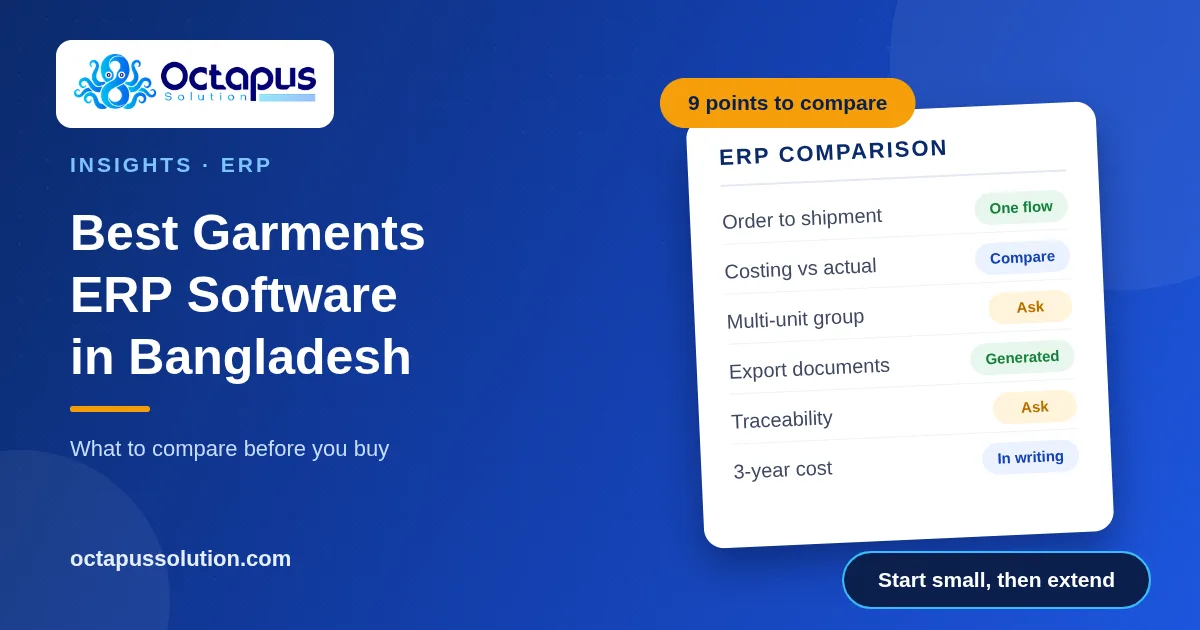
Every ERP vendor in Bangladesh says theirs is the best garments ERP. The honest answer is that the best one is the one your people will still be using a year after go-live. This guide explains the types of ERP on offer, what to compare, and why so many ERP projects in garment factories stall.
Three kinds of ERP you will be offered
Type | Strength | Risk |
|---|---|---|
Global general-purpose ERP | Strong finance and a proven platform | Garment processes need heavy customisation, and cost rises with every change |
Local garments ERP | Built around orders, styles, bookings and export documents | Quality and support vary widely between vendors |
Custom-built software | Fits your process exactly on day one | You depend on one developer or a small team for every future change |
What to compare
Does it follow your order from start to finish? Order, supply, production, inspection, shipment and closing should be one flow, not separate modules that need retyping between them.
Costing against actuals. A cost sheet that is never compared with real consumption is only an estimate. Read why garment costing never matches actual production.
Group structure. If you have several units, such as garments, textile, accessories, washing or printing, can the system handle transfers between them and report for the group?
Commercial and export documents. These should be generated from order data, not typed again for every shipment.
Traceability. Buyers increasingly ask where material came from. The EU Digital Product Passport will ask for data many factories do not yet collect.
Implementation plan. Ask which module goes live first, how long it takes, and what your team must do. A plan to switch on everything at once is a warning sign.
Who supports it. Will you talk to the people who built the software, or a reseller?
Total cost over three years. Licence, implementation, customisation, hardware, training and annual support together.
Your data. Can you export everything in a usable format if you leave?
Why ERP projects fail in garment factories
Buying on features, not on process. The demo looked complete, but nobody mapped how an order moves through your factory today.
No owner inside the factory. The project belongs to the vendor and IT, not to the people who run merchandising, stores and production.
Everything at once. Ten modules go live together and none is used properly.
Excel survives. If people keep a parallel spreadsheet, the ERP data goes stale within weeks.
Dirty master data. Duplicate items, styles and suppliers make every report wrong from the first day.
A sensible way to start
Pick the area that hurts most, often attendance and payroll, stores, or order tracking, and get it running well. Then extend. An ERP that covers 30% of the factory and is trusted is worth more than one that covers 100% on paper.
Where Octapus fits
We build Matrix ERP for vertically integrated garment groups in Bangladesh: production, textile, accessories, lab, finance, commercial and HR in one system, designed with the Digital Product Passport in mind. It is in beta, and we say so plainly. We are taking a small number of early access groups, not selling it as a finished product.
Two of our products are already live and can be a first step: Octa Punch for biometric attendance and payroll, and Trimflow for label and accessories manufacturing. If you are comparing ERPs this year, use the nine points above on every vendor, including us.