
Earned Leave Calculation in Bangladesh: Entitlement, Encashment and Worked Examples for Garment Workers
How earned leave works for garment workers in Bangladesh: one day for every 18 days worked, the 40-day limit, encashment rules, the formula and a worked example.
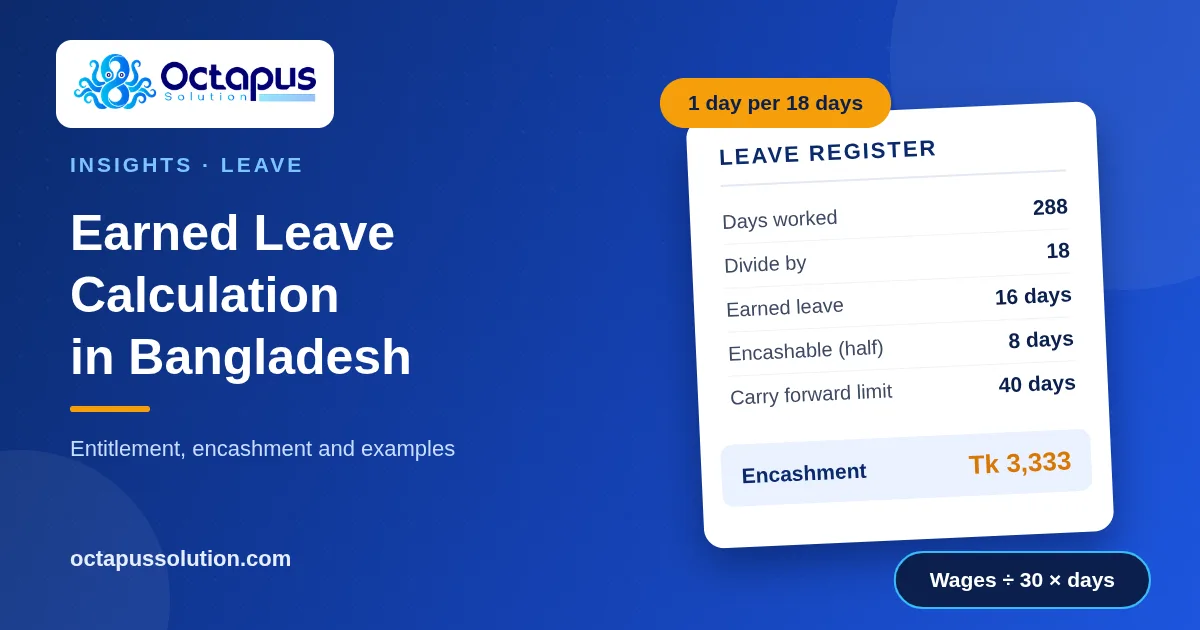
Earned leave, also called annual leave, is the leave a worker builds up by working. It is one of the most disputed lines in a garment factory's payroll, because it depends on days actually worked and it turns into money when it is encashed or when a worker leaves. This guide explains the rule, the calculation and the common mistakes.
What the law says
Under Section 117 of the Bangladesh Labour Act, 2006, an adult worker who has completed one year of continuous service in a factory earns one day of paid leave for every 18 days of work performed in the previous twelve months.
Holidays, paid leave, sick leave, maternity leave and lay-off do not break continuous service. This article covers factories. Other types of establishment have different rates.
How to calculate earned leave days
Earned leave days = days worked in the previous 12 months ÷ 18
Days worked in the year | Calculation | Earned leave |
|---|---|---|
306 | 306 ÷ 18 | 17 days |
288 | 288 ÷ 18 | 16 days |
270 | 270 ÷ 18 | 15 days |
252 | 252 ÷ 18 | 14 days |
The count is of days worked, so it has to come from the attendance record, not from the calendar. Write down in your leave policy how fractions of a day are treated, and apply it the same way to everyone.
How much leave can be carried forward?
Leave not taken in one twelve-month period is added to the next. For factory workers the balance can build up to 40 days. Once a worker reaches that limit, no more leave accumulates until some is used or encashed.
Earned leave encashment
Rule 107 of the Bangladesh Labour Rules, 2015 allows a worker to take cash for unused earned leave. In practice:
A worker can encash up to half of the leave earned in the year.
Encashment is allowed once a year.
Encashment is the worker's choice. It should not be forced, and the remaining leave stays available to take.
The encashment formula
As commonly applied in the industry, following labour inspectorate guidance:
Encashment = previous month's wages (excluding overtime and bonus) ÷ 30 × days encashed
Worked example
An assistant operator worked 288 days in the last twelve months. Her wages last month, without overtime and bonus, were Tk 12,500. She chooses to encash the maximum.
Step | Calculation | Result |
|---|---|---|
Earned leave | 288 ÷ 18 | 16 days |
Maximum encashable | 16 ÷ 2 | 8 days |
Daily rate | 12,500 ÷ 30 | Tk 416.67 |
Encashment | 416.67 × 8 | Tk 3,333 |
Leave still available | 16 − 8 | 8 days |
What happens when a worker leaves?
If a worker resigns, retires or is terminated with earned leave still due, the factory must pay wages in place of that leave as part of the final settlement. This is where missing leave records become expensive, because the worker's count and the factory's count have to match.
Mistakes auditors find in leave records
Leave calculated from the calendar, not from days worked. Every worker gets the same number, which cannot be right.
No leave given in the first year, and none credited after it. The entitlement starts after one year, counted on the work already done.
Balances over the limit, or cut without record.
Forced encashment. Workers are paid out every year and never allowed to take the leave.
Encashment on the wrong wage. Overtime wrongly included, or allowances wrongly removed.
Leave register and attendance disagree. A day marked as leave in one and absent in the other. See what auditors check in working hours records.
Frequently asked questions
Is earned leave paid on basic or gross? Leave pay is based on the worker's full-time wages for the previous month, without overtime and bonus. That is different from overtime, which is calculated on basic. See how to calculate overtime.
Does a worker get earned leave in the first year? The right to take it begins after one year of continuous service.
Has the law changed? The Labour Act was amended in 2026. Check the current Act and Rules, or ask your compliance adviser, before changing your leave policy.
Keep leave and attendance in one place
Earned leave goes wrong when attendance is on the device, leave is on paper and salary is in a spreadsheet. Octa Punch keeps them together: punches become the daily card, approved leave is cleared in the review queue, and each employee profile carries its leave balance. When a worker asks how many days they have, the answer is a lookup.