
Garment Worker Salary Sheet in Bangladesh: Wage Grades, Basic, Allowances and Deductions Explained (With Examples)
How a garment worker's monthly wage is built in Bangladesh: the four wage grades, basic and allowances, overtime, deductions, and two worked salary sheet examples.
Every month, a garment factory turns thousands of punches into one document: the salary sheet. It decides what each worker takes home, and it is the first thing a buyer's auditor asks for. Most salary sheet problems do not come from bad intent. They come from not being clear about how the wage is built. This guide walks through the structure, with worked examples.
How a garment worker's wage is built
Under the RMG minimum wage gazette, a worker's monthly gross wage has five parts:
Basic wage. The base for overtime, absence deductions and most benefits.
House rent. 50% of basic.
Medical allowance. Tk 750.
Transport allowance. Tk 450.
Food allowance. Tk 1,250.
The three fixed allowances add up to Tk 2,450 in every grade. Only basic and house rent change from grade to grade.
Grade-wise minimum wage
The structure effective from December 2023 has four worker grades:
Grade | Typical posts | Basic | House rent | Medical + transport + food | Gross |
|---|---|---|---|---|---|
Grade 1 | Senior operator, senior cutter, senior quality inspector | Tk 8,390 | Tk 4,195 | Tk 2,450 | Tk 15,035 |
Grade 2 | Operator, cutter, quality inspector | Tk 7,882 | Tk 3,941 | Tk 2,450 | Tk 14,273 |
Grade 3 | Junior operator, junior cutter | Tk 7,400 | Tk 3,700 | Tk 2,450 | Tk 13,550 |
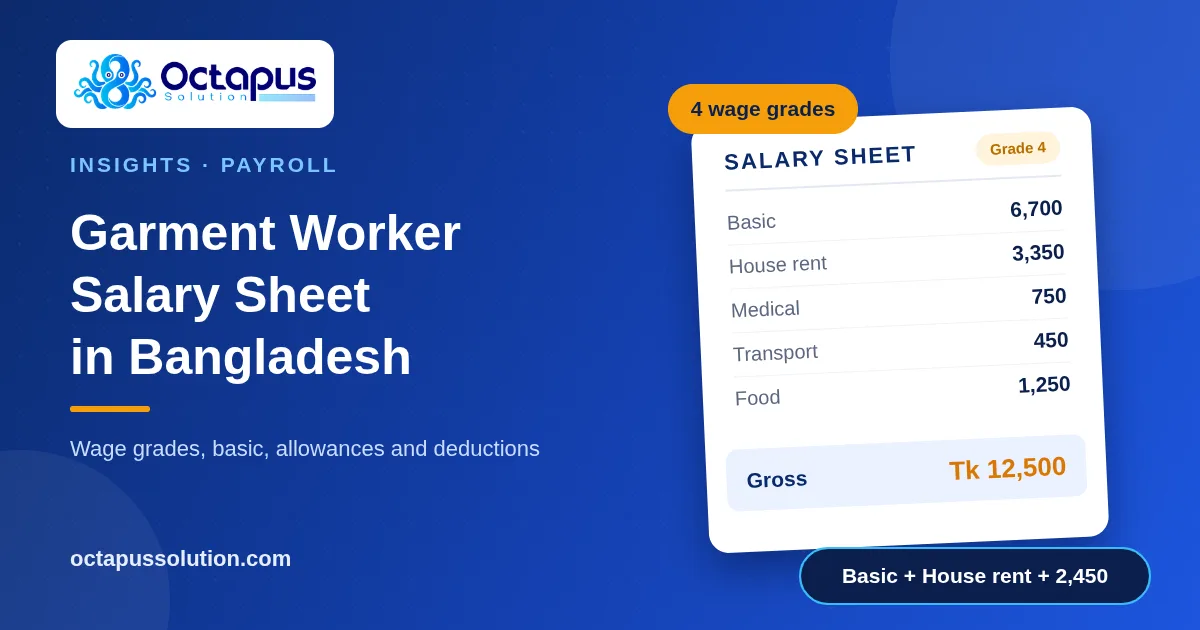
Grade 4 | Assistant operator, helper, finishing assistant | Tk 6,700 | Tk 3,350 | Tk 2,450 | Tk 12,500 |
These are minimums. A worker's actual basic is usually higher because of annual increments. The gazette set the increment at 5%, and the government raised it to 9% from December 2024. Always calculate from each worker's current basic in the wage register, not from the gazette table.
What gets added on the salary sheet
Overtime. Paid at twice the hourly basic: Basic ÷ 208 × 2 × overtime hours. Our guide on how to calculate overtime for garment workers covers this in detail.
Attendance bonus. Not fixed by the gazette. It is set by factory policy, so the rule must be written down and applied the same way to everyone.
Other earnings. Production incentives, night allowance, tiffin or holiday allowance, depending on your policy.
What gets deducted
Absence without leave. Deducted on basic, not gross: Basic ÷ 30 × days absent.
Revenue stamp. Tk 10 on the wage payment.
Advances and other lawful deductions. Only the types the Labour Act allows, and each one must be traceable to a record.
Worked example 1: Grade 4, full attendance
An assistant operator at the Grade 4 minimum works the full month with 40 overtime hours. The factory pays a Tk 600 attendance bonus (this amount is an example; yours follows your own policy).
Line | Calculation | Amount |
|---|---|---|
Gross wage | 6,700 + 3,350 + 2,450 | Tk 12,500 |
Overtime | 6,700 ÷ 208 × 2 × 40 | Tk 2,577 |
Attendance bonus | Factory policy | Tk 600 |
Stamp | − Tk 10 | |
Net payable | Tk 15,667 |
Worked example 2: Grade 3, two days absent
A junior operator at the Grade 3 minimum is absent without leave for 2 days and works 52 overtime hours. The attendance bonus is lost under the factory's policy.
Line | Calculation | Amount |
|---|---|---|
Gross wage | 7,400 + 3,700 + 2,450 | Tk 13,550 |
Absence deduction | 7,400 ÷ 30 × 2 | − Tk 493 |
Overtime | 7,400 ÷ 208 × 2 × 52 | Tk 3,700 |
Stamp | − Tk 10 | |
Net payable | Tk 16,747 |
Six salary sheet mistakes auditors find
Overtime calculated on gross. The factory overpays every month, or the formula is "corrected" in a way that underpays.
Absence deducted on gross. The worker loses more than the law allows. This is a common audit finding.
Increments not applied on time. The basic in the sheet is last year's basic, so overtime and benefits are short as well.
Grade does not match the job. A worker running a machine is still paid as a helper months after promotion.
Mid-month joiners and leavers. Pro-rata is done differently by different payroll officers.
Attendance and payroll disagree. Paid days and overtime hours on the sheet do not match the punch record. See what auditors check in working hours records.
What the pay slip should show
Each worker should receive a pay slip for the wage period, in a language they can read. In a Bangladeshi factory that means Bangla. It should show:
Name, ID, designation and grade
Days present, leave days and days absent
Basic, house rent and each allowance
Overtime hours, rate and amount
Each deduction with its reason
Net payable
A worker who can read their own slip raises fewer disputes, and an auditor who interviews that worker hears the same numbers that are on your sheet.
Fix it once, not every payday
Excel can produce a correct salary sheet. The trouble starts when something changes: a new gazette, a 9% increment for 3,000 workers with different joining dates, a revised attendance bonus rule. Every formula has to be found and edited by hand, and one missed cell becomes an audit finding.
Octa Punch builds the salary sheet from the attendance record itself. Wage grades, allowances, overtime and deduction rules are settings, not formulas, so they can be changed without a developer. Punches flow into the daily card, the daily card into the salary sheet, and every worker gets a Bangla PDF pay slip that matches it.