
Why Label and Trim Orders Run Late: 7 Bottlenecks From Inquiry to Delivery (and How to Fix Them)
A small label can hold up a whole garment shipment. Here are the seven places label and trim orders lose time between inquiry and delivery, and how to fix each one.
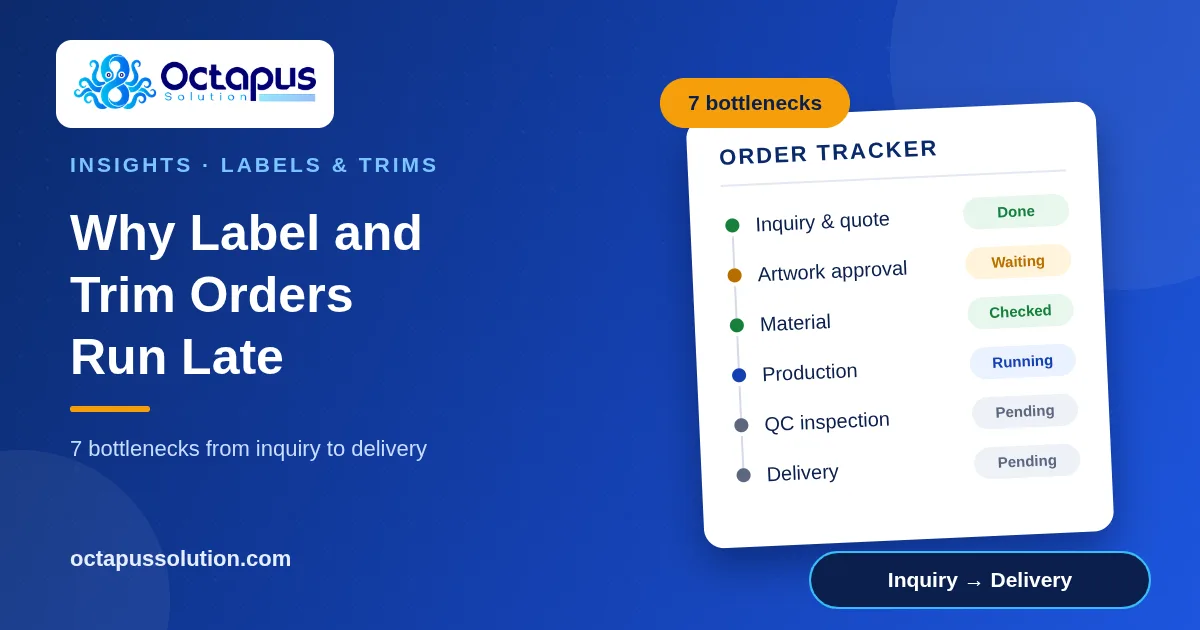
A care label costs a fraction of a taka. The shipment it belongs to is worth thousands of dollars. When the label arrives late, the garment factory cannot finish, the cartons cannot close, and the phone calls start. For a label, tag or accessories factory, delivery on time is the product.
Most late orders are not caused by a slow machine. The time is lost in the gaps between departments. Here are the seven places it usually goes, in the order an order travels.
1. Quotes that take days
The inquiry arrives by email or WhatsApp. The price depends on a cost sheet that lives in one person's Excel file. If that person is busy or on leave, the customer waits. When the quote finally goes out, nobody can say later which cost assumptions were behind it.
Fix: give every inquiry a number the moment it arrives, build quotes from a shared cost sheet, and freeze that cost sheet when the quote is sent.
2. Artwork approval loops
This is the largest single source of delay. Artwork goes back and forth as attachments. Version 3 is approved in a WhatsApp message, version 2 is what reaches the floor, and the full run is rejected.
Fix: keep one artwork record per item with numbered versions and a recorded approval. Production should only be able to run against an approved version.
3. Order details retyped by hand
Size, colour, quantity and fold type are typed from the customer's PO into a sales order, then typed again into a job card. Every retyping is a chance to turn 15,000 into 1,500 or the wrong Pantone.
Fix: enter the specification once. The sales order line should carry the spec and the approved artwork, and the job card should be created from that line, not typed fresh.
4. Delivery dates promised before stock is checked
The salesperson confirms Thursday. On Tuesday the store finds the yarn, paper or ribbon is short, or the only lot on hand does not carry the certification the order needs.
Fix: hold stock by lot, with quantity, warehouse and certification claim, and check it before the date is confirmed. For certified orders, see our guide to GRS and FSC traceability for label factories.
5. Nobody knows where the job is
The customer calls to ask about their order. The merchandiser calls the floor. The floor supervisor walks to the loom. Twenty minutes later there is an answer, and it is already out of date.
Fix: bind each job card to a routing, so every step from loom or press to cutting, folding and packing is recorded as it finishes. Order status then becomes a lookup, not a walk.
6. Quality problems found at the end
A colour or size problem that starts at the first step is discovered at final inspection, or worse, by the customer. The remake uses the time the order no longer has.
Fix: inspect in process, record the result against the job, and let the sampling plan decide pass or fail so the verdict does not depend on who is in a hurry.
7. Deliveries that do not match the order
Goods leave in two or three partial deliveries. The challans are written by hand. At month end, nobody is sure what is still owed on the order, and the invoice is disputed.
Fix: issue every challan against the sales order, so delivered and balance quantities are always known and the invoice follows the challan.
A weekly order review checklist
Which inquiries are older than two days without a quote?
Which orders are waiting for artwork approval, and for how long?
Which confirmed orders do not yet have material allocated?
Which job cards are behind their planned step?
Which orders have failed an inspection this week?
Which orders have a balance quantity still to deliver?
If answering these six questions takes more than a few minutes, the delay is already built into your process.
Fix the gaps, not the people
In most trim factories each department does its job well. Orders run late because the handover between them happens on paper, in Excel and in chat messages. Chasing people harder does not close those gaps.
Trimflow puts the whole journey in one system: numbered inquiries, quotes that lock their cost sheet, versioned artwork approval, sales orders that require a spec and approved artwork, stock by lot, job cards bound to a routing, QC inspections, and delivery on a challan with the invoice following. Every order has one status that everyone can see.