
GRS and FSC Traceability for Label and Trims Factories: A Practical Guide
What buyers and auditors expect when you supply recycled-polyester labels or FSC paper tags: scope and transaction certificates, lot traceability, and the 2026–2027 standard changes
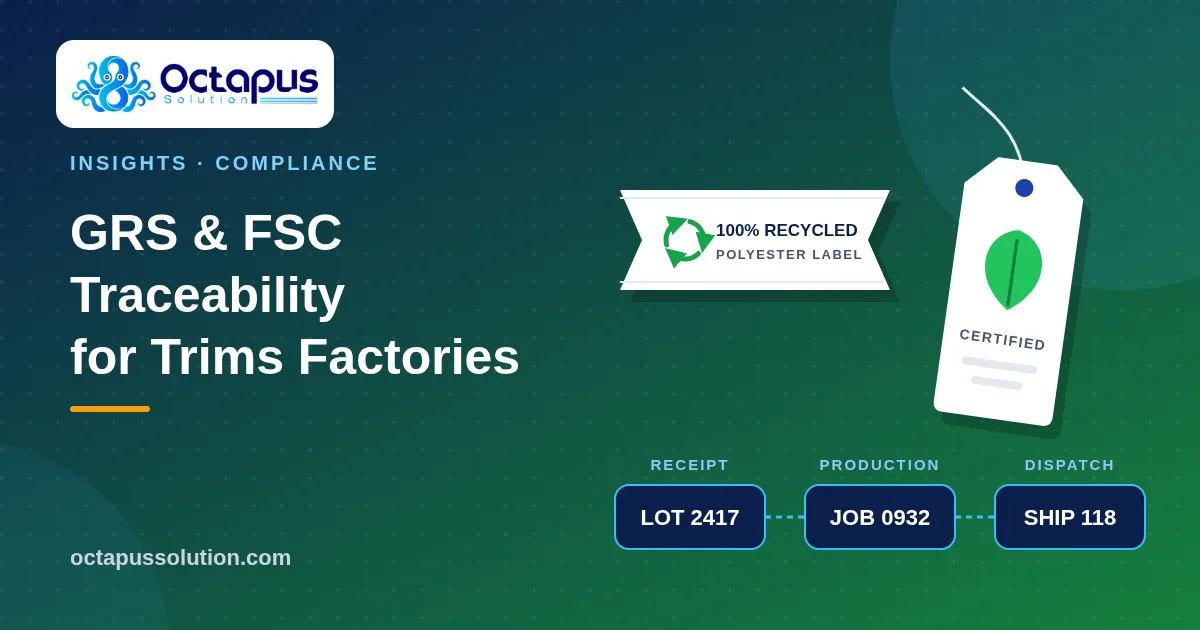
GRS (Global Recycled Standard) is owned by Textile Exchange. It verifies recycled content (such as recycled polyester yarn) and tracks it through the supply chain using a chain of custody. Brands ask for it when their products carry recycled claims.
FSC (Forest Stewardship Council) certifies paper and board from responsibly managed forests and recycled sources. For trims factories, it mostly applies to paper hang tags, swing tickets, cartons and packaging. FSC products carry claims such as FSC 100%, FSC Mix and FSC Recycled.
Both work on the same principle: certified material must be traceable from the moment it arrives to the moment it leaves your factory, with documents to prove it.
The documents that matter
Scope certificate (SC): Shows your factory is certified, and for which products and processes. Brands check that it's valid and covers what you're selling them.
Transaction certificate (TC): For GRS, a TC verifies that a specific shipment of certified goods was sold from one certified company to another. Your yarn supplier's TC proves your input is certified. Your buyer may need a TC from you to make their own claim.
FSC chain of custody (CoC) code and invoice claims: FSC-certified sales must show your CoC code and the correct FSC claim on invoices and delivery documents. Using FSC labels or logos on products also requires FSC trademark approval.
What auditors actually check
Auditors follow the material, not just the paperwork. Expect them to pick a finished order and ask you to show:
Receipt: Which certified lot (with supplier TC or FSC invoice) the material came from.
Storage: That certified material was kept separate or clearly identified in the store.
Production: Which job card or work order used that lot, and how much.
Output: How many labels or tags were produced, plus wastage.
Dispatch: Which delivery and invoice the certified goods went out on, with the correct claim.
They will also do an input-output reconciliation: certified material in versus certified product out. If you sold more certified labels than your certified yarn or paper could produce, the audit fails.
Common reasons factories fail
Certified and non-certified yarn or paper mixed in the store without labeling
Job cards that don't record which material lot was used
Wastage not recorded, so the reconciliation doesn't balance
Invoices missing the claim or certificate code
Supplier TCs or certificates that have expired or don't cover the material
Records kept in separate spreadsheets that don't link together
Changes coming in 2026–2027
Textile Exchange is moving its recycled standards into a new Materials Matter Standard. It was published in December 2025, becomes effective on 31 December 2026 and becomes mandatory from 31 December 2027. The new standard mainly applies at the raw-material and primary-processing stage (for example, recyclers). Downstream manufacturers, including label and trims factories, generally keep tracking certified material through chain of custody requirements. Check with your certification body how the transition applies to your certificate and what changes to claims and documents you need to plan for.
Textile Exchange has also published updates to GRS and RCS that tighten how reclaimed material is tracked, with a mandatory date at the end of 2026.
Make traceability a by-product of production
Traceability works best when it's built into daily operations rather than reconstructed before the audit. Trimflow records certified lots at receipt, links them to artwork approval, MRP and job cards, tracks QC and wastage on the shop floor, and ties each dispatch back to its source lots, so an audit trail exists for every order automatically. Book a free demo to see how it handles GRS and FSC orders.