
Best HR and Payroll Software in Bangladesh: A Buyer's Checklist for Garment Factories
How to compare HR and payroll software in Bangladesh if you run a garment factory: a 10-point checklist, the questions to ask in a demo, and what to look for in pricing.
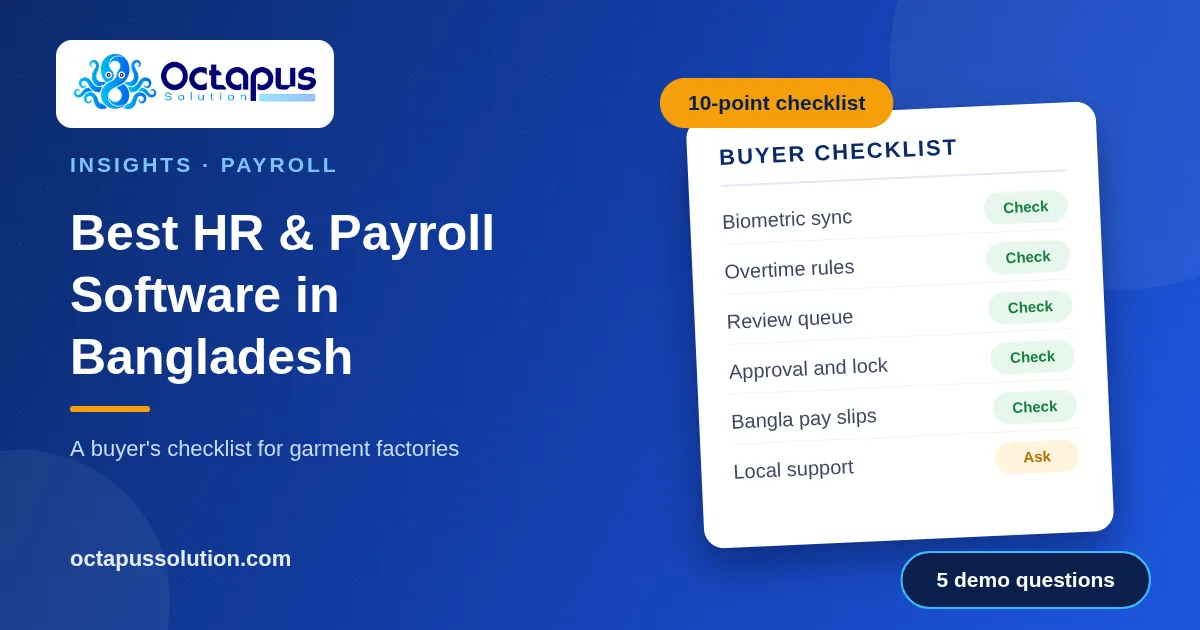
Search for the best HR and payroll software in Bangladesh and you will find a dozen products that all promise the same things. For a garment factory, most of the difference shows up later, on the first payday with 2,000 workers and three shifts. This checklist helps you compare any payroll software, including ours, on the points that matter on a factory floor.
Why garment payroll is different
Office payroll is a fixed salary and a few leave days. Garment payroll is built from attendance: thousands of punches, overtime on basic wage, wage grades, attendance bonus, absence deductions and pay slips in Bangla. Software designed for offices can do the arithmetic, but it leaves the hard part, turning punches into payable hours, to Excel.
The 10-point checklist
Biometric integration. Does it read your attendance devices directly and live, or does someone export and import files?
Punches to worked hours. Does it pair in and out punches, subtract breaks and derive overtime from the shift, or do you still do that by hand?
Exceptions. Missed punches, half days and odd shifts should land in a review queue, not hide inside the sheet.
Labour law rules. Overtime at twice the hourly basic, wage grades, increments and lawful deductions should be settings you can change when the rules change. See our guides on overtime calculation and the garment salary sheet.
Approval and locking. A salary sheet should move through draft, approval and payment, then lock. Ask to see who changed what, and when.
Pay slips workers can read. Bangla pay slips, printable in bulk.
Audit readiness. Can you answer an auditor's question about one worker's month in a minute? Read what auditors check in working hours records.
Leave and HR records. Leave balances, employee documents and joining dates in the same system as payroll.
Data security. Roles and permissions, encrypted documents, and your data kept separate from other customers.
Support. Who answers when the sheet does not close on the 5th? A local team that knows the product, or a ticket queue?
Questions to ask in the demo
Show me a worker with a missed punch. How is it fixed, and who can see the fix?
Change the overtime rule in front of me. Did it need a developer?
Generate the salary sheet for a month from raw attendance. How long did it take?
Print the pay slip. Is it in Bangla?
Export all my data. What format do I get?
A vendor who can do these live, on realistic data, is worth a second meeting. A vendor who shows slides instead is telling you something too.
What about price?
Compare the full cost for a year: licence or subscription, setup, device integration, training and support. A low monthly fee with paid customisation for every rule change is not the cheaper option. Ask for the price in writing, per worker or per factory, with what is included.
Where Octa Punch fits
We build Octa Punch, so judge it with the same checklist. It is made for garment and textile factories in Bangladesh running ZKTeco biometric attendance. Punches become a daily card, odd days go to a review queue, and the salary sheet is generated from attendance. Sheets move from draft to submitted, approved, paid and locked, with an audit trail on every change. Pay slips are bilingual PDFs, four to an A4 page. Each business is fully isolated, with its own roles and permissions.
It is not the right tool for every company. If you run an office with fixed salaries and no attendance devices, a general HR package will serve you well. If your payroll starts at the factory gate, book a demo and bring the five questions above.