
ERP for Label and Garment Accessories Factories: What a Generic ERP Misses
Label, tag and trim factories do not run like garment factories. Seven things a generic ERP misses, a side-by-side comparison, and the questions to ask any vendor.
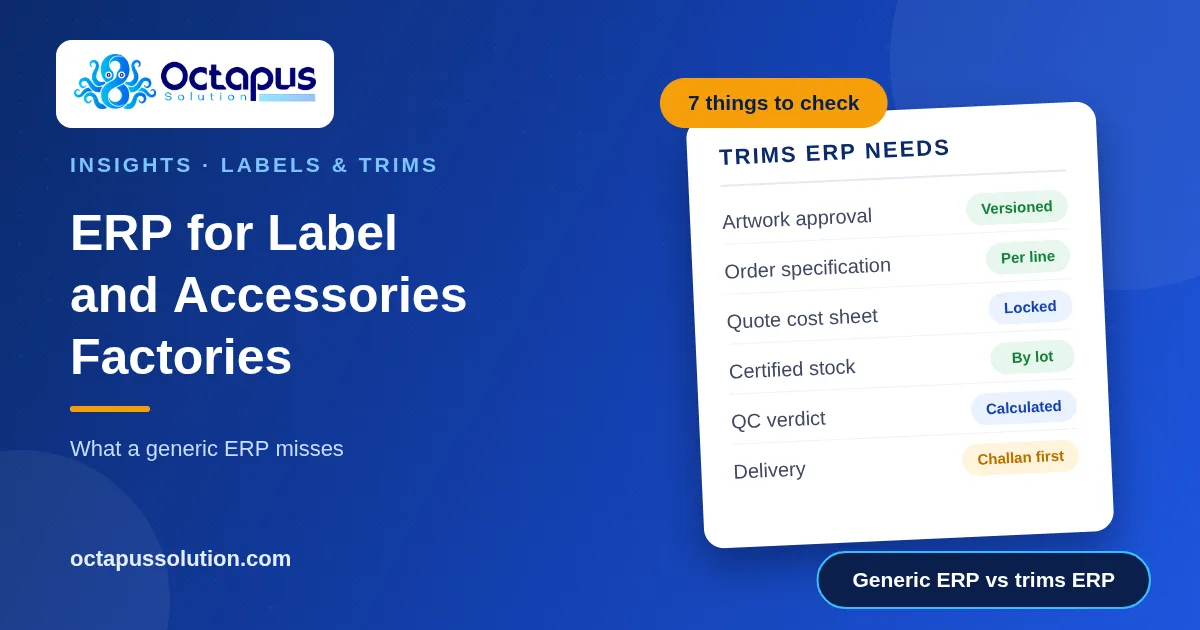
A label factory and a garment factory both make things for the apparel trade, but they do not run the same way. A garment factory handles a few hundred styles a year. A label, tag or accessories factory handles thousands of small orders, each with its own artwork, size set and delivery date measured in days. An ERP designed for general manufacturing, or for garments, misses most of what makes this business hard.
1. Artwork is part of the order
In trims, the product is the artwork. A general ERP treats it as an attachment. A trims ERP needs numbered artwork versions, a recorded customer approval, and a rule that production cannot start without an approved version.
2. Small items, large quantities, many variants
One order line can be 200,000 care labels across twelve sizes and four colourways. The system has to hold a full specification for each line, such as material, size, fold, colours and finish, without someone creating a new item code for every combination.
3. Quotes are constant, and margin is thin
Trim factories quote all day. Each quote needs a cost sheet, and the cost sheet behind a sent quote should be frozen so that the margin you promised is the margin you can check later.
4. Routing changes by product type
A woven label goes from loom to cutting and folding. A printed label goes through a press. A hang tag has printing, die-cutting and stringing. A fixed bill of operations does not work. Each job card needs a routing that matches the product.
5. Certification follows the lot
GRS, FSC and similar claims belong to a specific lot of yarn, paper or ribbon. If stock is held only as a total quantity, you cannot prove which certified lot went into which order. See our guide to GRS and FSC traceability for label factories.
6. Quality is sampled and tested
Buyers expect AQL inspection results and lab tests such as colour fastness and wash performance. These should be recorded against the job, with pass or fail calculated from the sampling plan and not typed in by hand.
7. Delivery comes before the invoice
Goods leave on a challan, often in several partial deliveries, and the invoice follows. The system has to track delivered and balance quantity per order line. Late and mismatched deliveries are covered in why label and trim orders run late.
Generic ERP versus a trims ERP
Need | Generic ERP | ERP built for trims |
|---|---|---|
Artwork approval | File attachment | Versioned, approval required before production |
Item variants | New item code each time | Specification on the order line |
Quote costing | Outside the system | Cost sheet locked with the quote |
Routing | Fixed | Per product type, bound to the job card |
Certified stock | Total quantity | Lot with certification claim |
QC | Pass or fail typed in | AQL verdict calculated, lab tests recorded |
Delivery | Invoice first | Challan first, invoice follows |
Questions to ask any vendor
Show me an order that cannot go to production because artwork is not approved.
Show me which stock lot was used for a certified order.
Show me the cost sheet behind a quote sent last month.
Show me the balance still to deliver on a part-shipped order.
Built for this kind of factory
Trimflow is our manufacturing ERP for factories making woven and printed labels, hang tags, tickets and other garment trims. Inquiries are numbered on submit, a sent quote locks its cost sheet, production only runs against an approved artwork version, stock is held by lot with its certification claim, job cards are bound to a routing, AQL verdicts are computed, and goods leave on a challan with the invoice following. It is live and running on real factory floors.