Service Benefit Calculation Under Bangladesh Labour Law (2026)
How service benefit is calculated under the Bangladesh Labour Act after the 2026 amendment: days per year by separation type, the basic wage base, rounding and worked examples.
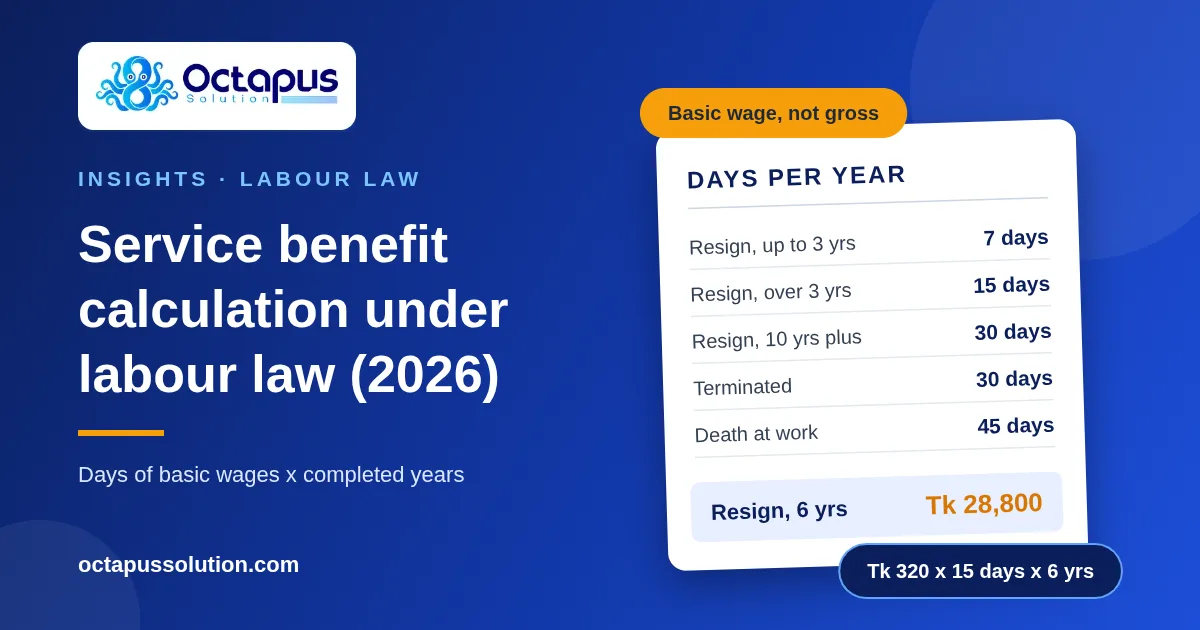
Service benefit in Bangladesh is calculated as days of wages x completed years of service, and the number of days depends on how the job ended. A permanent worker who resigns now gets 7 days' wages per completed year for service up to 3 years, 15 days for more than 3 but less than 10 years, and 30 days for 10 years or more. A worker terminated, retrenched, discharged or retired gets 30 days per year. The resignation rule changed with the Bangladesh Labour (Amendment) Ordinance 2025, later passed as the Bangladesh Labour (Amendment) Act 2026.
This is general guidance, not legal advice. Check the current gazette or a labour lawyer before settling a disputed case.
What changed in 2025 and 2026
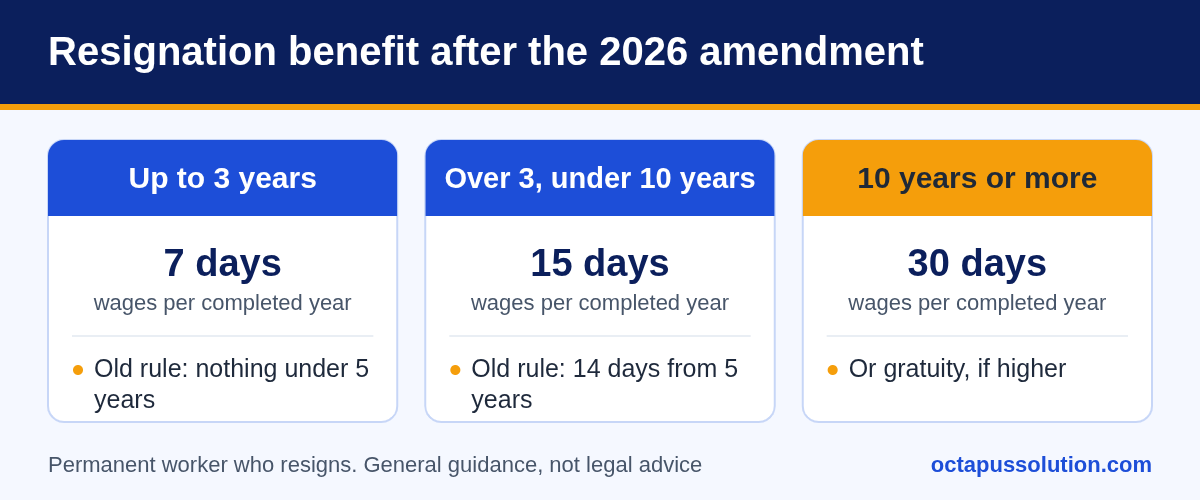
Before the amendment, section 27 gave nothing to a worker who resigned with under 5 years of service, 14 days' wages per year for 5 to under 10 years, and 30 days for 10 years or more. Many payroll sheets still use that rule. It is out of date.
Resignation (section 27(4)): the three tiers above. Payment now starts from the first completed year.
Death (section 19): the service threshold fell from more than 2 years to more than 1 year.
Dismissal (section 23(3)): the wording on compensation for dismissed workers was amended. Take advice on any case that turns on it.
Sections 20, 22, 26 and 28 and the gratuity definition in section 2(10) appear unchanged in the 2026 Act.
Benefit by type of separation
How the job ends | Section | Who qualifies | Benefit per year of service |
|---|---|---|---|
Resignation | 27 | Permanent worker | 7 days (up to 3 years), 15 days (over 3, under 10), 30 days or gratuity if higher (10 or more) |
Termination by employer | 26 | Permanent worker | 30 days or gratuity if higher, plus 120 days' notice or pay in lieu (60 days if not monthly-rated) |
Retrenchment | 20 | At least 1 year of service | 30 days or gratuity if higher, plus one month's notice or pay in lieu |
Discharge for ill health | 22 | At least 1 year of service | 30 days or gratuity if higher |
Dismissal for misconduct | 23 | At least 1 year of service | 15 days. Nothing for theft, fraud, riot or arson type misconduct |
Retirement at 60 | 28 | Retiring worker | As section 26(4) or the factory's own service rules: 30 days or gratuity if higher |
Death in service | 19 | More than 1 year of service | 30 days, or 45 days if death happened at work or after a workplace accident, or gratuity if higher |
These payments are on top of unpaid wages, overtime and earned leave encashment. Section 30 requires final dues to be paid within 30 working days.
Which wage is used: basic, not gross
Section 14(3) says that for these compensation payments, wages means the average of basic wages plus dearness allowance and any ad hoc or interim pay over the 12 months before separation. House rent, medical, transport and food allowances are not in the base.
Gratuity is worded differently. Section 2(10) uses the wage the worker last received: at least 30 days per year, or 45 days per year when service is more than 10 years. Factories commonly apply this to the last basic wage. Gratuity is compared with compensation only "if payable", which is commonly read as applying where the factory runs a gratuity scheme.
In practice one day's wage is taken as monthly basic divided by 30.
Counting years and the six-month rule
Under section 14, a worker who actually worked 240 days in the preceding 12 months has completed one year. 120 days counts as six months. Lay-off days, sick or accident leave, legal strike days and maternity leave count as days worked.
Sections 26 and 27 pay for each completed year. A part year is not rounded up.
Gratuity and the death benefit do round. A part year of more than six months counts as a full year.
So 6 years 7 months is 6 years for resignation compensation, but 7 years for gratuity.
Worked examples
1. Resigns after 2 years 8 months. Average basic Tk 8,400, so one day is Tk 280. Two completed years x 7 days = 14 days. Benefit: Tk 3,920. Under the old rule it was nil.
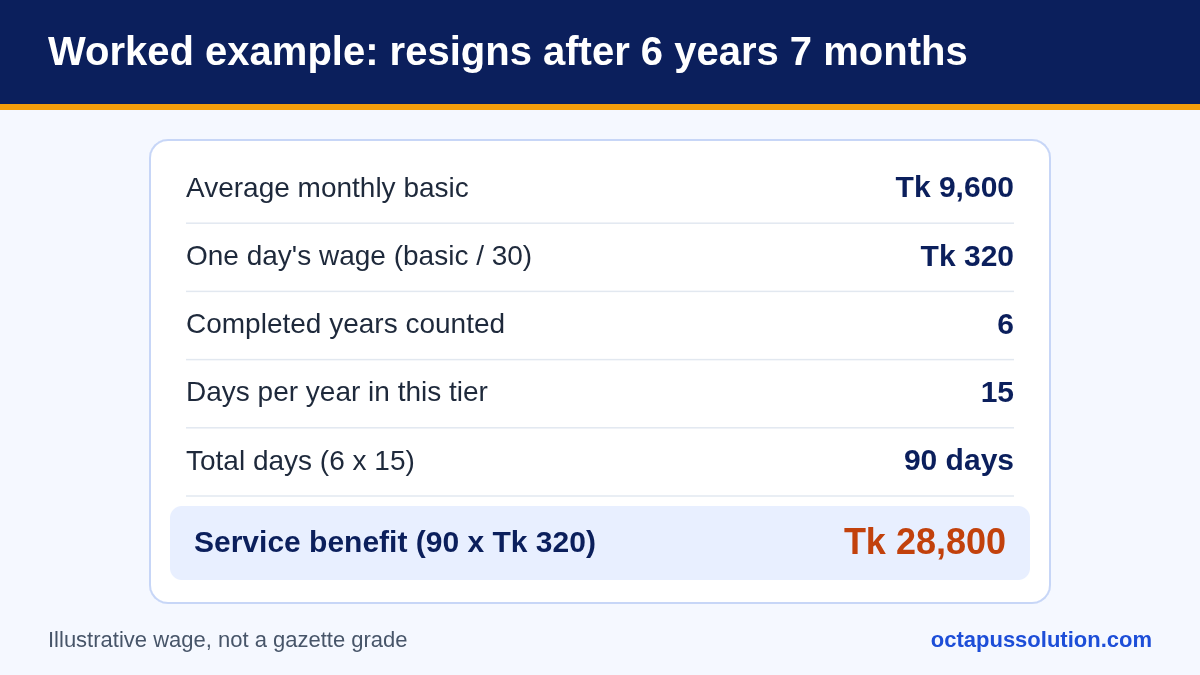
2. Resigns after 6 years 7 months. Average basic Tk 9,600, one day Tk 320. Six years x 15 days = 90 days. Benefit: Tk 28,800.
3. Terminated after 6 years 7 months, same wage. Compensation: 6 x 30 = 180 days = Tk 57,600. If the factory has gratuity: 7 x 30 = 210 days = Tk 67,200. The worker gets the higher figure, Tk 67,200, plus notice or pay in lieu.
4. Dies after 4 years 8 months, not work related. Basic Tk 9,000, one day Tk 300. The part year rounds up, so 5 x 30 = 150 days. The nominee receives Tk 45,000. For a death at work it is 5 x 45 = 225 days, Tk 67,500, separate from workplace injury compensation.
Common mistakes
Still paying resignations on the old 5-year and 14-day rule.
Calculating on gross wages, or on last month's basic where the law asks for the 12-month average.
Rounding up part years for resignation and termination, or failing to round for gratuity and death.
Paying compensation and gratuity together, or paying the lower of the two. The law gives whichever is higher.
Moving a worker who has exactly 3 years to the 15-day tier. The law says more than 3 years.
Treating a long-absent worker as resigned without the notices section 27(3A) requires.
Weak service records. Joining dates and wage history must match the salary sheet and attendance records an auditor will ask for.
Frequently asked questions
Does a worker who resigns before one year get service benefit? No. The payment is for each completed year, so there is nothing to multiply. Wages and other earned dues are still payable.
Is service benefit calculated on basic or gross salary? On basic, plus dearness allowance and ad hoc or interim pay if any, averaged over the last 12 months.
Do temporary workers get resignation benefit? Section 27(4) covers permanent workers only.
Does a dismissed worker get anything? With at least one year of service, 15 days' wages per completed year, unless the misconduct was theft, fraud, riot, arson or similar. Other lawful dues are always paid.
Where Octapus fits
A settlement is only as good as the records behind it: joining date, days worked each year and twelve months of basic wages. Octa Punch is our biometric attendance and payroll system for garment factories, with BDT payroll and Bangla PDF pay slips, so that history sits in one place and can be exported in full when you need to work out a final payment.
It will not replace a lawyer's reading of a disputed case. It does mean the numbers going into the formula are ones you can show an auditor.
TopicPayroll