Garments ERP Modules and Process Flow, Explained
The modules a garments ERP normally has, what each one records and who uses it, the order flow from buyer inquiry to export realisation, and which modules to start with.
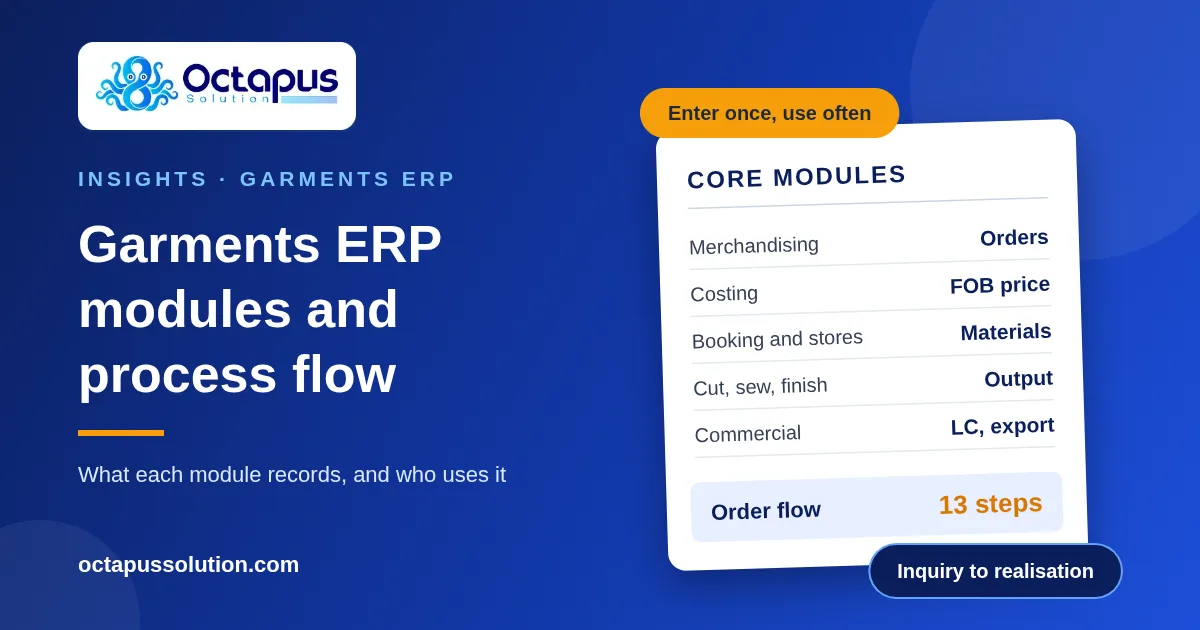
A garments ERP is normally built from about fourteen modules: merchandising and order management, costing, TNA, sampling, fabric and trims booking, stores, cutting, sewing, finishing, quality, commercial, finance, HR and payroll, and maintenance. Each one records a different part of the same order. ERP stands for Enterprise Resource Planning: one system and one database for the whole business, instead of a separate spreadsheet in every department.
ERP full meaning, in factory terms
The full form is Enterprise Resource Planning. In a garment factory the resources are fabric, trims, machines, people, time and bank limits. The planning is deciding how much of each an order needs and checking what was actually used.
The test of an ERP is simple. A figure is entered once, by the person who owns it, and every other department reads the same figure.
The modules and what each one records
Module | What it records | Who uses it |
|---|---|---|
Merchandising and order management | Buyer, style, tech pack, purchase order by colour and size, price, delivery dates | Merchandisers |
Costing | Fabric and trims consumption, CM, wash, print, commercial and other charges, quoted FOB price | Merchandisers, management |
TNA | Planned and actual dates for every milestone of the order | Merchandisers, planning |
Sample | Sample requests, types, submission dates, buyer comments, approvals | Sample room, merchandisers |
Fabric and trims booking, procurement | Bill of materials, bookings, purchase orders, supplier prices, delivery promises | Merchandisers, purchase |
Inventory and stores | Goods received, inspection results, stock by order, issues to the floor, leftovers | Store officers |
Cutting | Markers, lay quantity, cut quantity by size, bundle numbers, fabric used | Cutting in-charge |
Sewing | Line plan, input, hourly output, WIP, line efficiency | Production, IE, planning |
Finishing | Wash send and receive, iron, poly, carton quantity, packing list | Finishing in-charge |
Quality | Fabric inspection, inline and end-line defects, final inspection results | Quality team |
Commercial (export and import) | Master LC or sales contract, back-to-back LCs, import and export documents, bank submissions, realisation | Commercial officers |
Finance | Vouchers, payables, receivables, bank liabilities, cost and profit by order | Accounts |
HR and payroll | Employee records, attendance, leave, overtime, wages | HR, payroll, compliance |
Maintenance | Machine list, breakdowns, servicing, spare parts | Maintenance team |
Vendors name and group these differently. Some put TNA and sampling inside merchandising. Some sell cutting, sewing and finishing as one production module. Compare what is recorded, not the menu names.
Why the commercial module matters so much in Bangladesh
Generic manufacturing ERPs are weakest here. Most export orders in Bangladesh are financed through a back-to-back LC: the bank opens an import LC for fabric and trims on the strength of the buyer's master LC or contract, and that import bill is later settled from the export proceeds.
So the commercial module has to hold the link between the two sides. For each master LC or contract it should show:
the export value and the shipment and expiry dates
every back-to-back LC opened against it, with value and maturity date
how much of the limit is used and how much is left
shipments made, documents submitted to the bank, and proceeds realised or still outstanding
If your ERP cannot answer "what is still unrealised and what falls due this month", the commercial team will keep its Excel file, and finance will keep asking them for it.
The process flow, from inquiry to realisation
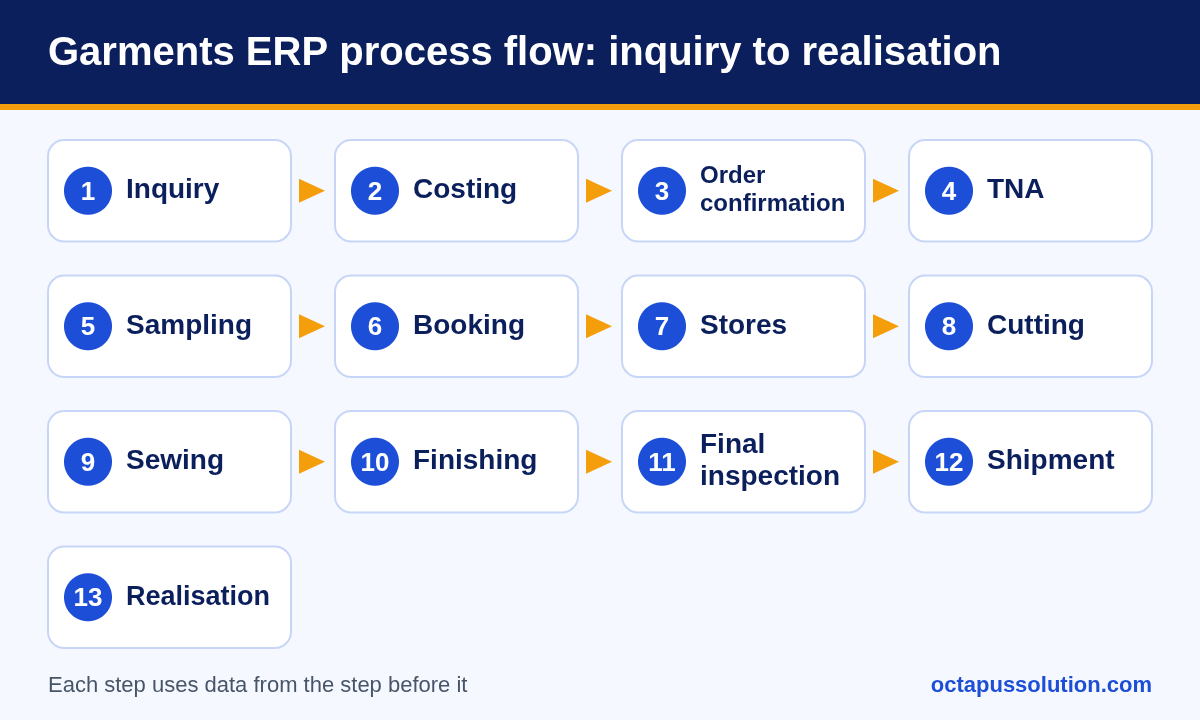
Inquiry. The buyer sends a tech pack. Merchandising creates the style.
Costing. Consumption is worked out and a price is quoted.
Order confirmation. The purchase order is entered by colour and size. The master LC or sales contract is recorded in commercial.
TNA. A time and action calendar is set, working back from the shipment date.
Sampling. Fit samples, lab dips and the pre-production sample are submitted and approved.
Booking. Fabric and trims are booked from the bill of materials. Back-to-back LCs are opened.
Stores. Materials arrive, are inspected and are stocked against the order.
Cutting. After the PP meeting, fabric is issued and cut. Bundles are numbered.
Sewing. Lines take input and report hourly output. Inline quality checks run alongside.
Finishing. Washing if needed, then ironing, folding and packing into cartons.
Final inspection. The buyer's or a third-party inspector passes the lot.
Shipment. Commercial prepares the invoice, packing list and export documents. Goods are handed over.
Realisation. Documents go to the bank, proceeds come in, back-to-back liabilities are settled and the order's profit is closed.
Each step uses data from the step before it. That is the point of one system. The booking quantity comes from the order and the costing sheet. The store issues against the booking. Cutting reports against the issue. Finance compares it all to the original costing, which is how you find out where the costed margin went.
Which modules to start with
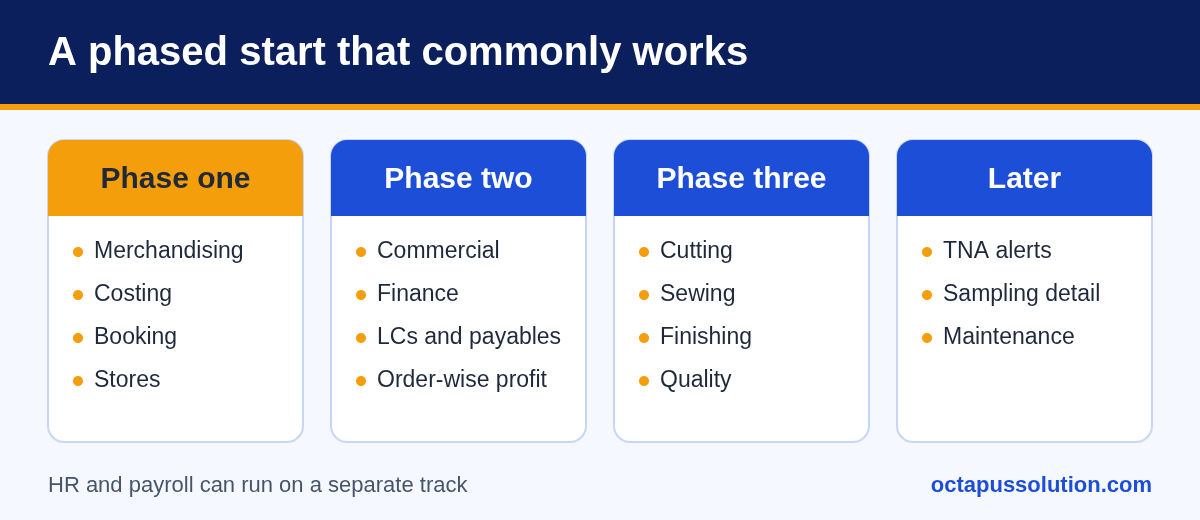
Do not go live with fourteen modules on one day. A phased start that commonly works:
Phase one: merchandising, costing, booking and stores. This is where the order, the bill of materials and most of the money sit. Fabric alone is usually the largest part of garment cost, so controlling booking and stock pays back first.
Phase two: commercial and finance. Once orders and purchases are in the system, LCs, payables and order-wise profit can be built on real data.
Phase three: cutting, sewing, finishing and quality. Floor data needs discipline every hour of every shift. Add it when the office modules are stable.
Later: TNA alerts, sampling detail and maintenance.
HR and payroll can run on a separate track. Many factories already have an attendance and payroll system that works, and there is no need to replace it on the first day. What matters is that labour cost can reach finance.
Before choosing a product, read our guide to garments ERP software in Bangladesh, which covers how to compare vendors.
Frequently asked questions
What is the full meaning of ERP? Enterprise Resource Planning. It means one shared system for orders, materials, production, money and people.
Is accounting software an ERP? No. Accounting software records vouchers after the event. An ERP records the order, booking, stock and production that create those vouchers, so accounts are a result of operations and not a separate data entry job.
Does a small factory need every module? No. A factory with a few lines can get most of the benefit from order management, costing, booking, stores and commercial. Add floor modules when someone is available to own the data.
How long does implementation take? It depends on the factory size, the number of modules and how clean your existing data is. Plan in phases of a few months each and ask the vendor for references from factories like yours.
Where Octapus fits
Matrix ERP is our group ERP for vertically integrated garment manufacturers. It is designed to run from yarn to export carton, with production, textile, accessories, lab, finance, commercial and HR in one system. It is in beta, and we are taking a small number of early-access groups.
If you run a single cut-and-sew unit, a lighter product may suit you better today, and we will say so. If you run a group with its own knitting, dyeing or accessories units and want to be an early user, get in touch through the product page.
TopicERP