TNA in Garments: Full Form, Meaning and a Working Calendar
TNA in garments means Time and Action calendar. What it contains, who owns it, how to plan backwards from the shipment date, a sample 90-day TNA, and why TNAs fail.
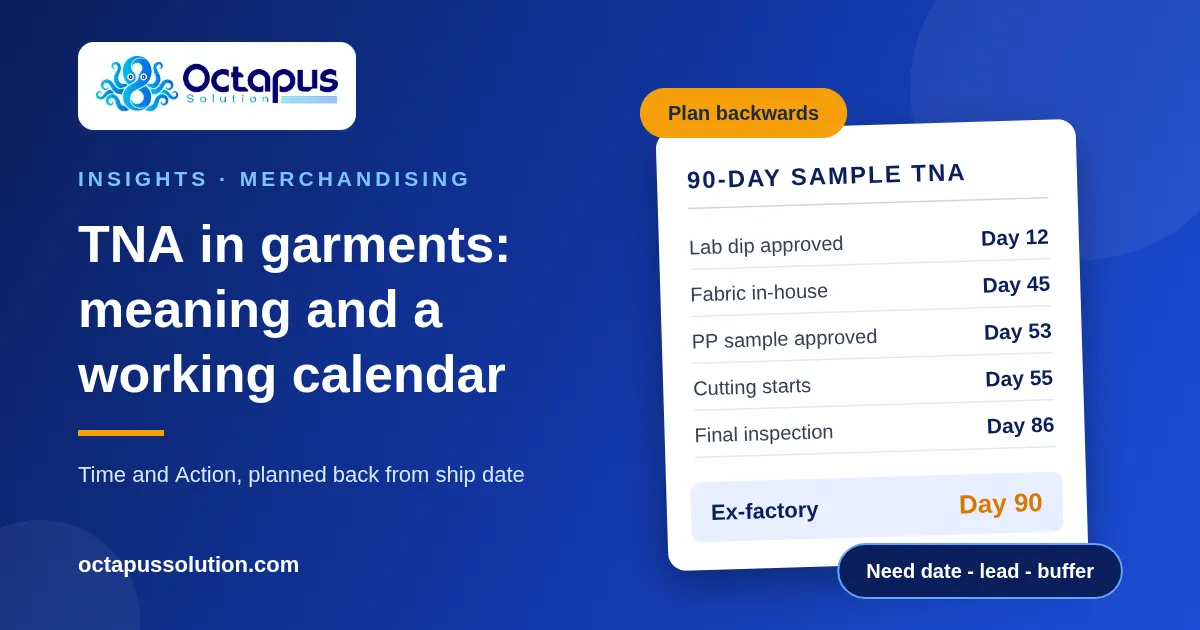
TNA in garments means Time and Action calendar. It is a dated list of every task that must be finished between order confirmation and ex-factory, with a planned date, an actual date and a responsible person for each. It is also written T&A. The merchandiser owns it and uses it to see, weeks ahead, whether the shipment date is at risk.
What a TNA is and who owns it
A garment order has dozens of dependent steps. Fabric cannot be cut until it is in-house and inspected. Bulk cutting should not start until the pre-production sample is approved. One late approval moves everything after it.
The TNA puts those steps on a calendar so that a delay is visible on the day it happens and not in the last week. For each milestone it holds four things: planned date, actual date, owner and status.
The merchandiser prepares the TNA when the order is confirmed and remains its owner, because the merchandiser is the one link between buyer, suppliers and the factory floor. But the merchandiser does not own every task. Stores owns the in-house dates, the sample room owns sample submission, production owns cutting and sewing. A good TNA names that person on each line.
The usual milestones
Order confirmation and receipt of the purchase order and tech pack
Lab dip submission and approval (colour)
Fit sample submission and approval (measurement and construction)
Fabric booking and bulk fabric in-house, followed by inspection and any testing
Trims booking and trims in-house: labels, hang tags, buttons, zippers, poly, cartons
PP (pre-production) sample submission and approval
PP meeting with production, quality and the merchandiser
Cutting start
Sewing start and finish
Washing, where the style needs it
Finishing and packing complete
Final inspection
Ex-factory
Buyers add their own steps, such as size set samples, print or embroidery strike-offs, garment tests and shipping samples. Keep the list to milestones that can actually delay shipment. A TNA with eighty lines does not get updated.
How to build one by backward planning
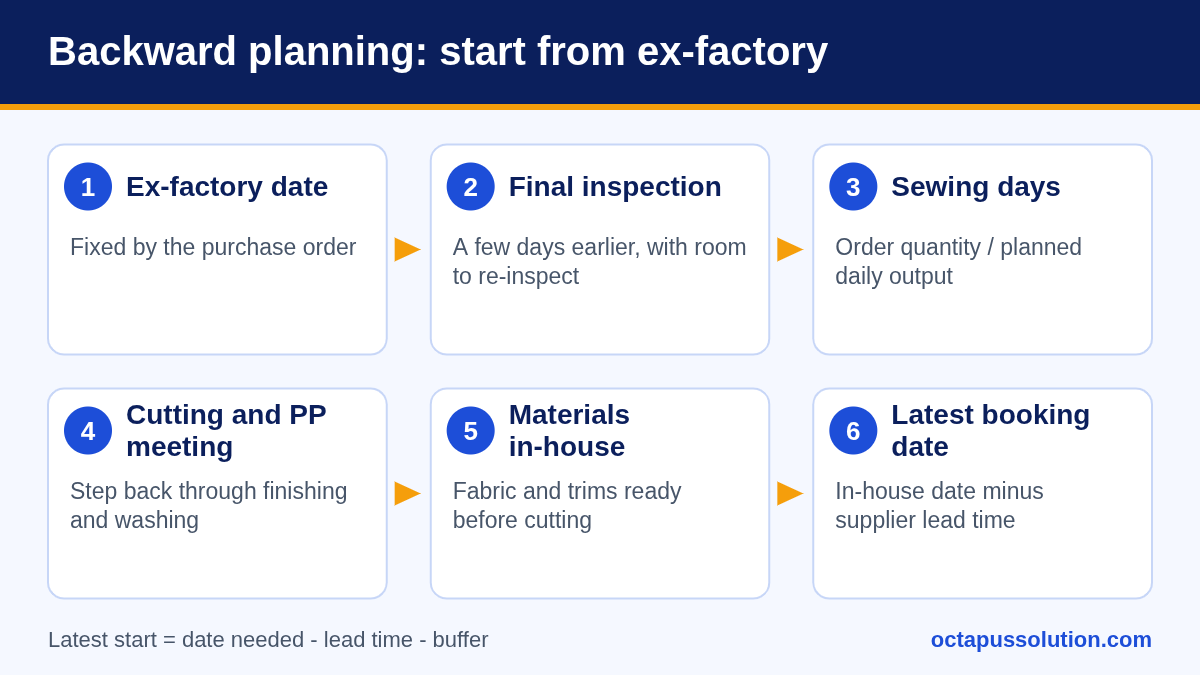
Start from the date you cannot move, which is ex-factory, and work backwards.
Fix the ex-factory date from the purchase order.
Place final inspection a few days before it, leaving room for a re-inspection.
Work out sewing days: order quantity divided by planned daily output across the lines you will give it. A 30,000-piece order on two lines making 850 pieces a day each needs about 18 working days.
Step back through finishing, washing, cutting and the PP meeting.
That gives the date materials must be in-house. Subtract each supplier's quoted lead time to get the latest booking date.
Place approvals so they are complete before the booking or cutting they unlock.
Add a buffer before the dates that hurt most, and count working days only. Take out Fridays and the Eid holidays.
The rule for every line is the same: latest start = date needed, minus lead time, minus buffer. If the calendar shows fabric should have been booked last week, you have learned that on day one. That is the time to negotiate with the buyer.
A sample TNA for a 90-day order
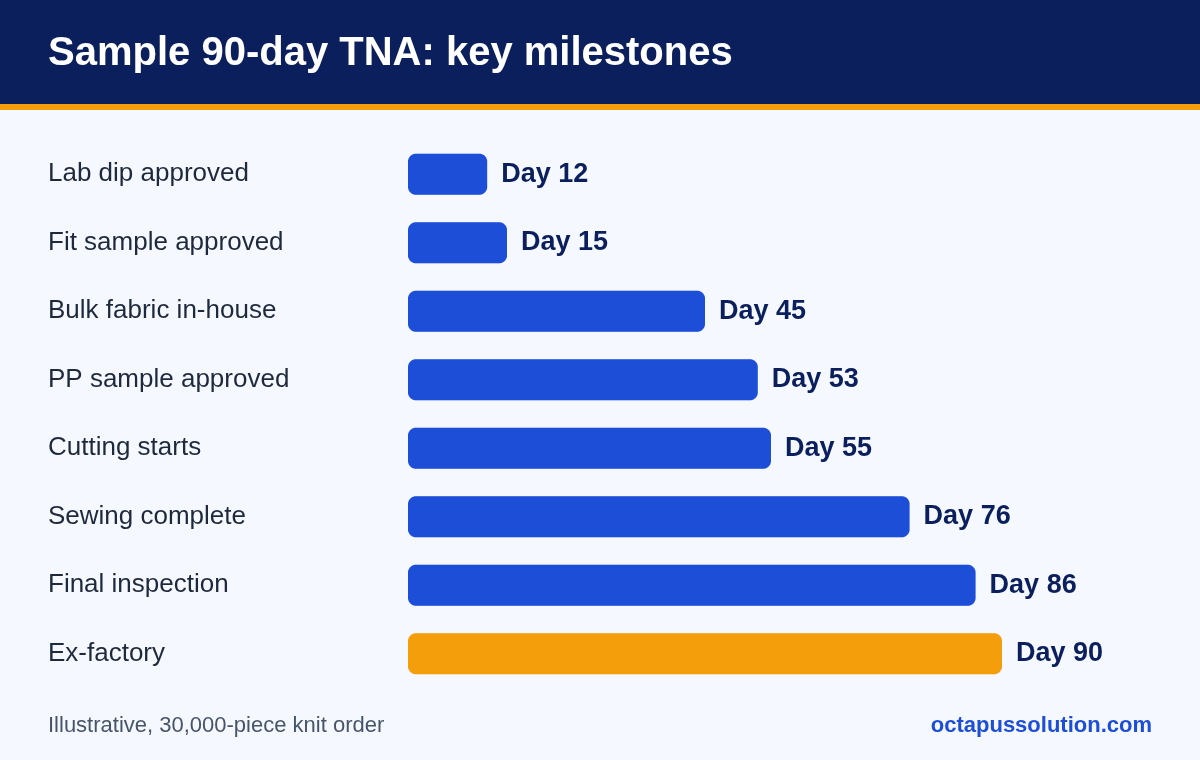
This is an illustration for a 30,000-piece knit order with locally sourced fabric and a light garment wash. Day 0 is order confirmation and day 90 is ex-factory. Your day numbers will differ with fabric source, buyer approval times and line capacity. Imported woven fabric needs a much longer fabric lead time than this.
Milestone | Planned day | Owner |
|---|---|---|
Order confirmation, PO received | 0 | Merchandiser |
Fabric booking | 3 | Merchandiser |
Lab dip submitted | 5 | Merchandiser, dyeing |
Fit sample submitted | 7 | Sample room |
Trims booking | 10 | Merchandiser |
Lab dip approved | 12 | Buyer |
Fit sample approved | 15 | Buyer |
Bulk fabric in-house | 45 | Stores |
Trims in-house | 48 | Stores |
PP sample submitted | 48 | Sample room |
PP sample approved | 53 | Buyer |
PP meeting | 54 | Production, quality |
Cutting starts | 55 | Cutting |
Sewing starts | 58 | Production |
Sewing complete | 76 | Production |
Washing complete | 80 | Wash |
Finishing and packing complete | 84 | Finishing |
Final inspection | 86 | Quality |
Ex-factory | 90 | Commercial, merchandiser |
Notice how little slack there is. Sewing takes 18 days, from day 58 to day 76. If lab dip approval slips from day 12 to day 20, bulk dyeing starts late, fabric arrives around day 53 and cutting moves to about day 63. The only way to recover eight days is a third line or overtime, and both cost money.
Why TNAs fail
Static Excel. The sheet is made on day one and emailed. When a date moves, nobody recalculates the dates that depend on it, so the plan and the factory drift apart.
No owner per task. If every line belongs to "merchandising", stores and production do not treat the dates as theirs.
No alerts. A missed date is found only when someone opens the file. With thirty running orders, nobody opens thirty files a day.
Approvals stuck with the buyer. Lab dips and samples wait for comments while the factory's clock keeps running. Without a record of submission and reply dates, the factory cannot show where the days were lost.
Supplier dates taken on trust. Trims are a frequent cause. See why label and trim orders run late.
What a TNA inside an ERP does differently
Actual dates fill themselves. When stores posts the fabric receipt, "fabric in-house" is marked done. Nobody retypes it.
Dependent dates move. A late approval pushes the linked tasks and shows the new projected ex-factory date.
Each owner sees their own list. Tasks due this week, across all orders, on one screen.
Exceptions are pushed. Management sees only the orders that are behind, not every line of every order.
History is kept. Submission and approval dates are logged, which helps when discussing a delay with the buyer.
An ERP does not fix a TNA nobody respects. Tasks still need owners, and someone still has to review the late list every week.
Frequently asked questions
What is the full form of TNA in garments? Time and Action. It is the calendar of tasks and deadlines for an order, also written T&A.
Who prepares the TNA? The merchandiser handling the order, usually with the planning department, after collecting lead times from suppliers and capacity from production.
What is the difference between a TNA and a production plan? The TNA covers the whole order from confirmation to ex-factory, including approvals and materials. The production plan covers only which line makes which style on which days.
How often should a TNA be updated? Whenever an actual date is known. Review the late and upcoming tasks at least weekly.
Where Octapus fits
Matrix ERP is our group ERP for vertically integrated garment manufacturers, covering production, textile, accessories, lab, finance, commercial and HR in one system. A TNA is only as good as the dates feeding it, and in a group those dates come from your own knitting, dyeing, lab and accessories units as well as the sewing floor. Having them in one system is what makes the calendar trustworthy.
Matrix ERP is in beta and we are taking a small number of early-access groups. If trims are your recurring delay and you run a label or accessories factory, Trimflow is live today.
TopicERP